

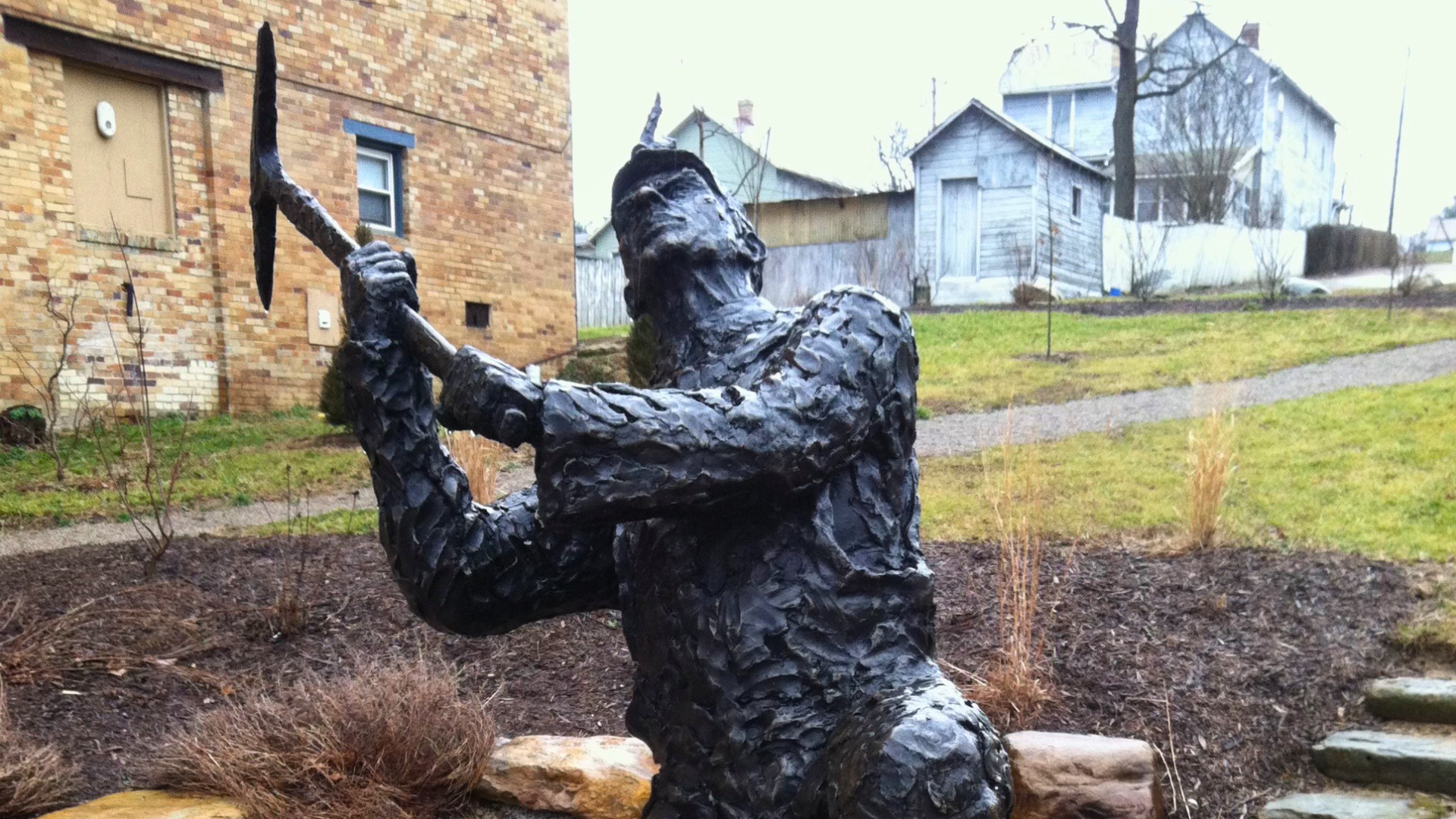
Deep in the Hocking Valley Coal Fields—a region comprised of Athens, Perry and Hocking counties—the boom of explosions and the drilling roar of metal on stone is a symphony as common as jazz in the streets of New Orleans.
According to an Ohio State graduate thesis by John William Lozier, coal in the Southeast region had been mined for personal use by settler-colonists as early as the late 1700s. Exploitative corporate mining operations expanded throughout the area, eventually employing an estimated 6,000 workers within the towns of the Hocking Valley Coal District.
Lethal working conditions, including falling shale and shoddy fuses, were a constant problem, worsened by the industrialized expansion of mining operations. Miners knew that, for coal barons, the company store was sometimes a bigger source of revenue than the coal sales, reinforcing miners’ sense of exploitation. A large surplus of miners also meant most worked three days a week, as opposed to five or six, and rarely had money for necessities. The miners were merely a source of profit for these companies.
Tensions between workers and coal capitalists in the Hocking Valley Coal District were extraordinarily high, and miners in the region eventually formed a statewide union called the Ohio Miners’ Amalgamated Association (OMAA). The corporation, a new merger known as the Columbus and Hocking Coal and Iron Company (derisively named by most miners in the region as “the Syndicate”), understood labor’s structural weakness in negotiations: an excess of miners meant they were easily replaced.
Kellye Blosser, a project manager and board member with the Little Cities of Black Diamonds (LCBD), joined the community organization with her fiancé, Tyler McDaniel, because of her passion for Southeast Ohio’s history and character. The LCBD is an organization dedicated to preserving the history, character and future of the collection of coal towns in the Hocking Valley and those who reside in them.
Blosser points out that throughout 1884, the Syndicate forced pay reductions from 70 cents per ton of coal to 50 cents per ton. She notes that during her research, she found that pay reduction was “roughly equivalent in 2025 to a $11,100 being cut to a $7,400 annual salary.”
Miners were also forced to purchase their own equipment for work, and repair it themselves when necessary, Blosser adds. This left miners with just over $6,000 in 2025 dollars.
“At this same time, I found a newspaper article that talked about a woman in New York City buying a painting for $20,000, and that’s not adjusted,” Blosser says. “That’s $20,000 in 1884. You’ve got miners that you want to pay 50 cents per ton, while the people paying them are buying decorations for their houses for $20,000. This was class warfare.”
Worse, the new contracts for miners included “ironclad” clauses, preventing miners from unionization or strikes. At the end of their ropes, union miners in Hocking decided that a strike was the only way to move forward. Three days after their pay was cut, miners stayed home from work. To combat the leverage labor utilized to gain pay during the strike, the Syndicate brought strikebreakers and laborers from Europe, known to miners as ‘blacklegs.’
Contrary to long-lasting dominant narratives of “reckless labor violence” against “helpless strikebreakers,” a research paper published in Ohio History notes that despite the occasional social friction, there existed tremendous solidarity and cooperation among strikebreaking labor and unionizing miners.
Union leaders in the area, like John McBride, thought of the new laborers as “deceived” and understood that their enemy was not the strikebreaker, but the coal baron himself. Eventually, many of those strikebreakers left in solidarity, and sympathy between groups of miners grew.
Tyler McDaniel, president of the LCBD, says that he was personally inspired by the historical example of worker unity. “All these different ethnic groups and races came together, and a lot of the blacklegs, once they found out what was happening, joined the union cause.”
The Athens Messenger reported in July 1884 that strikers even treated the strikebreakers to breakfast. However, this early victory in persuasion was a losing strategy, as hundreds of strikebreakers arrived steadily taking the places of striking miners. Meanwhile, the Syndicate began evicting striking miners with force, leaving already vulnerable workers without housing or income.
Blosser notes that in contemporary evaluations of the strike, too much emphasis is placed on the available surplus of labor in the Hocking Valley Coal District.
“When you’ve had people who, for years, have been working a job that is literally killing them… and they are doing this for $11,000 a year, and then you decide you’re going to cut that almost in half, and make them sign a contract saying they’ll never ask for more?” Blosser says. “You can talk about surplus of labor all you want, what caused the strike was not treating people like human beings.”
By this time, Hocking strikers armed themselves and threatened the coal operators with property destruction if evictions were carried out. These threats came to fruition on Oct. 11, 1884; According to a 1936 issue of Time magazine, “They placed timber in coal cars, soaked them with oil and kerosene, ignited them, and pushed them into five separate mines near New Straitsville.”
The rebellion caused multiple mine fires, a few of which are commonly said to have lasted for decades. Union miners also attacked any company property that was poorly guarded.
Eventually, striking miners were forced into the Syndicate’s terms, and the OMAA lost the fight for better pay. A lost battle, however, does not mean a lost war. The strike inspired other miners to assert their own rights and gain better conditions in the workplace across the state and the nation. This led to the formation of a nationwide miners’ union, United Mine Workers of America (UMWA).
Blosser and McDaniel also admired the dedication necessary to win basic unionization efforts. The formation of the UMWA, a direct consequence of the Hocking strikes, took over 25 years to come to fruition.
“They did not have fewer obstacles than we have today,” Blosser says. “They overcame them by building networks of people.”
The history of the labor movement in Southeast Ohio captures more than the fight for better conditions; it highlights the undying political spirit of resilience and resistance to big interests that characterize the region today.
“If you know the story, a lot of things make sense,” Blosser says. “We are very anti-authoritarian down here, very untrusting of corporate power or government power. There’s a strong sense for people that they’ve got to make it out on their own, and I truly think that it came from that era… I wish more people did know this story, because I think there’s a lot to be proud of.”
Find us on Social Media