
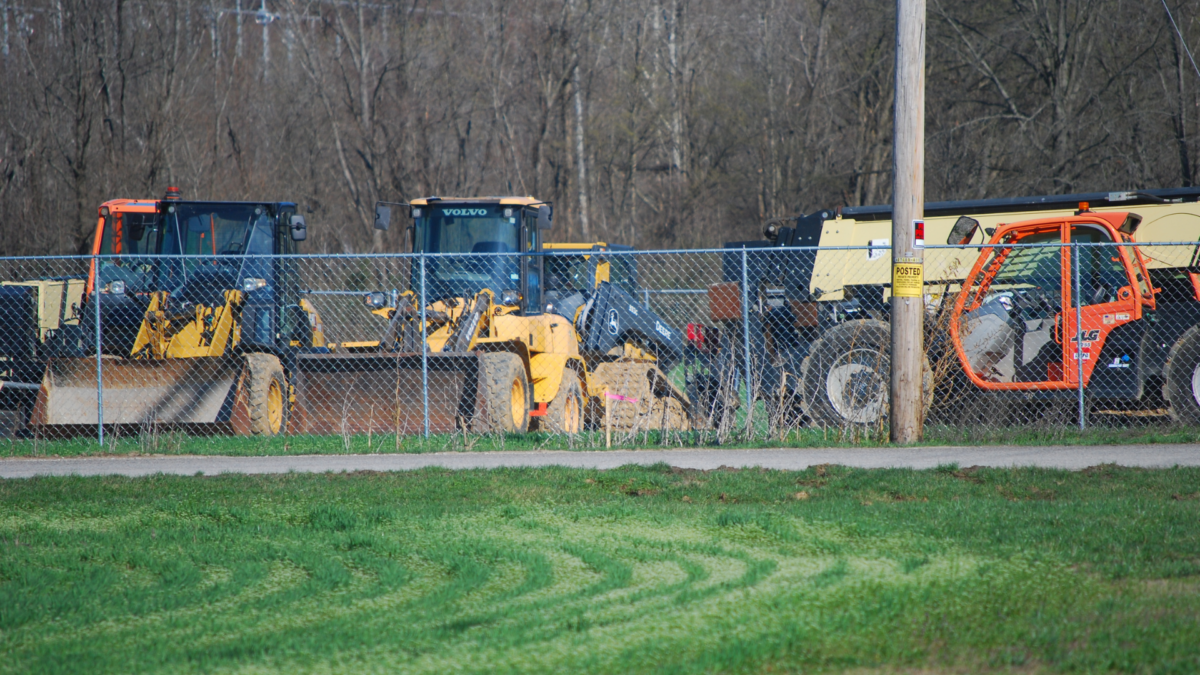

On Dec. 17, 2025, Danielle Fletcher watched construction workers build on an empty parcel of land adjacent to her home in Hamilton Township. Nestled by the river with a population of just over 1,500, the residents realized they were getting a new neighbor: an AI data center.
The next day, Fletcher began piecing together the details by reading stories from media outlets in the nearby city of Ironton reporting on a ribbon-cutting ceremony. Wanting more answers, she went to the construction site to take a closer look.
“I woke up to more construction and went over there,” Fletcher says. “I’m still in my pajamas, and I just started filming. Just updating the community, like, ‘Hey, this is happening.”
She quickly learned that her new neighbor, an AI data center, was the product of a joint venture between companies from Texas and Washington, Strata Expanse and RAVEL, which are working with another company called Supermicro.
Data centers have existed as long as the modern computer has, storing information, hosting websites or providing cloud services, such as streaming. AI data centers are used to support AI computing, providing space to store AI technology. Texas and Virginia have the highest concentration of centers, but Ohio is quickly catching up.
Strata Expanse practically acts as an ‘AI landlord’: they build data centers, which companies rent looking for digital space. The construction itself is outsourced to several companies, often based in other states like Utah and California, supplying energy-storage technology and the infrastructure for hydroelectric power.
Meanwhile, RAVEL supplies parts for computing systems, and Supermicro provides language learning models (LLMs) and generative AI programs. Simply, RAVEL provides the hardware, Supermicro creates the software and Strata Expanse builds the facility it is all stored in.
Strata Expanse calls the facility in Lawrence its first AI “Center of Excellence”, or COE, and details plans for more facilities in a press release posted on Dec. 19, 2025.
Jacob Hock, a member of Ironton City Council, was confused when he saw the city of Ironton cited in the press release.
“[The facility] is outside of the jurisdiction of Ironton City proper,” Hock says, adding he had no idea the company was moving in, nor did anyone else on the city council. “It kind of raised some red flags because they use Ironton in the press release, and they use Ironton on their website as a representation of their project spotlight.”
Realizing that officials in Ironton had as few answers as she did, Fletcher began to look elsewhere. One of her biggest concerns about the Strata expansion and the emergence of data centers in Lawrence is how these out-of-state companies plan to contain the growth.
Zoning was brought to the table as a potential regulatory check, or at least a means to prevent the construction of more data centers. Zoning laws divide land into districts, each with its own dedicated regulations on how parcels of land can be used.
None of the 14 townships in Lawrence County currently have zoning laws. This means that there is no regulation on what can be built on a plot of land. The lack of these laws makes it easy for companies to build freely in the area, Fletcher says.
Despite her best efforts, Fletcher’s attempt to bring zoning to the attention of her township’s trustees has been rocky.
“[Zoning] is a long, lengthy process,” Fletcher says. “I was trying to push for a special meeting, but that got shut down [quickly] by Bobby Blankenship (Hamilton Township Board of Trustees Member). I think that he puts the interests of the LEDC ahead of the interests and the well-being of the citizens of Hamilton Township.”
The LEDC, short for the Lawrence Economic Development Corporation, is a nonprofit organization that works with companies seeking to expand their businesses into Lawrence County. They essentially operate as a real estate agent, buying property in the area from the local community and then selling it to incoming companies.
The Strata Expanse sale was a three-parcel, 40-acre deal, totaling $1.8 million, according to Lawrence County auditor records. The purchase was finalized late last year.
The LEDC has been in business since 1983 and has worked with the community and board of trustees closely; Blankenship, who didn’t respond to requests for comment, even serves on its board of trustees.
“No one wants to do business in the dark,” Fletcher says. “People want information. “We want to know how this is going to affect our lives right now. Most of the information people are gathering is from other communities and other areas in our county.”
Data centers are suspected to be popping up in rural areas of Ohio for two reasons: cheaper land and lower energy costs. However, building in rural areas places a strain on existing energy grids and affects local communities already facing economic stress.
Strata Expanse asserts that they will create an “independent microgrid” to power the facility and claims it will have no impact on the local power grid. Hock, however, remains skeptical.
“I started reading more on what’s going on with investments from larger companies that are driving the infrastructure that they’re building,” Hock says. “They’re focusing on building these data centers in places that are economically disadvantaged and where they don’t feel like they’re going to get much public pushback.”
Lawrence County has a population of over 57,000 as of 2023, with 17.5% living below the poverty line. Approximately 68% of the county’s population participates in the workforce.

Strata Expanse claims they want to provide the area with jobs to energize the community, writing in a statement that “During development, projects typically support construction jobs over an approximately two-year period … In addition to construction employment, workforce training for long-term operations is a core component of the project approach.”
However, for many citizens of Lawrence County, the benefits do not outweigh the concerns, and pushback has become vocal. A Change.org petition created by one resident to stop the project has more than 5,000 signatures.
Most of the signers have left messages of concern, with a majority worried about the environmental impact of data centers.
Although the true environmental consequences won’t be understood for several years, it is no secret that data centers require an exorbitant amount of water and electricity to operate; some large data centers consume 1 to 5 million gallons of water daily. With excessive water usage comes the possibility of hazardous chemical runoff, posing a substantial risk to those who live nearby.
For Fletcher, this concern is even more troubling because she uses well water on her property and knows her neighbors do as well.

Strata Expanse claims in a written statement that they plan to use a combination of energy sources, such as solar, geothermal and gas, but Fletcher says those efforts at harm reduction simply aren’t enough.
“We as citizens want to know what their impact study is,” Fletcher says. “Have they even considered an impact study? What’s the exact layout of the engineered plan, what is it going to look like [and] how is it going to operate? There are three main things I’m concerned about… the water usage, how much my electricity is going to go up, and how loud it’s going to be.”
Despite the lack of answers, Fletcher remains vocal within her community. And though it’s been a frustrating search for answers, she’s been amazed by the community support she’s received while speaking out.
The amount of snow Ohio received in the winter months of 2026 led to low community turnout at township meetings, Fletcher says. However, she asserts that the low attendance does not reflect community interest, and she’s taken it upon herself to be a messenger. At the top of her to-do list is to push for zoning laws as a means of preventing construction.
“We’re limited with what we can do, but there are proper channels for zoning,” Fletcher says. “Don’t treat it like it’s a done deal. It’s not a done deal.”
She points out Ironton as an example of how to push back with legal means, which Hock brought up as a point of progress.
“We can’t zone them outright,” Hock says. “But by making certain stipulations, they’re not going to be interested in building one here because it would mean that they would have to put too much money into it.”
As for the bigger picture? Well, Fletcher is not afraid to make a direct impact.
“In 2027, we got a couple of chairs up for election in Hamilton Township,” Fletcher says. “So, if I have to be that change… I’ll work on it and see what I can do to better my community.”
Find us on Social Media