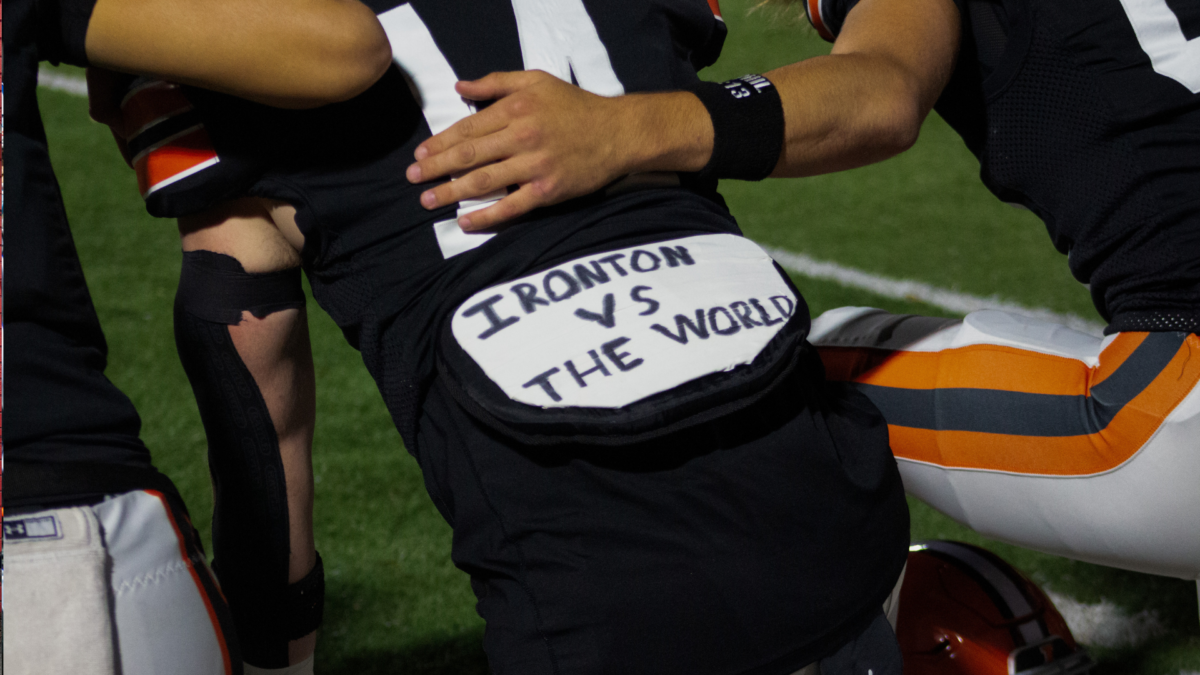

“Let’s Play Football!” the Ironton High School football team chanted on the steps of the City Schools building on Oct. 24, just hours before the Ohio High School Athletic Association (OHSAA) would release a statement banning the team from postseason play.
The protest came after Ironton was found to have violated numerous recruiting and transfer rules under OHSAA bylaws 4-7 and 4-9.
What Happened?
The OHSAA opened an investigation into the school ahead of the team’s week six matchup against Wheelersburg. OHSAA Director of Media Relations Tim Stried says several sources alerted the organization to Ironton’s potential recruiting activity, but he was unable to disclose the names of those sources. OHSAA bylaw 4-9 prohibits Ohio high schools from recruiting prospective students between grades 7-12 for any reason; in light of the alleged violations, student eligibility for several Ironton transfers suspended.
One of the transfers was senior running back Kylan Grace, whose family filed a lawsuit against the OHSAA in response to its investigation. Grace transferred from Hurricane High School, in West Virginia, to Ironton High School in Lawrence County in May 2025, and missed two games at the time of the filing Oct. 8.
According to court documents, Grace’s suit alleged that “Kylan and his parents will suffer irreparable harm as he loses the ability to play during his senior season, which will negatively affect his collegiate prospects.” During a hearing on Oct. 9, the OHSAA denied injunctive relief to Grace, which prevented any immediate changes in his eligibility.
Desperate to get Kylan back on the field, the Grace family filed for a temporary restraining order, which prevented the OHSAA from taking any immediate action, allowing their son to resume playing football.
OHSAA bylaw 4-7-2 provides requirements for transfers into Ohio high schools. In the first academic year after transferring, student-athletes are only permitted to play half of the team’s regular season games and are prohibited from participating in any postseason play. The bylaw has 11 exceptions that can rule a student-athlete fully or partially eligible for the season. The Grace family filed for Exception 1, which states that if an athlete’s immediate family completed a bona fide change of residence and maintains that residence for a full year, the previously stated ineligibility period would be waived. Grace’s affidavit required for Exception 1 approval was submitted to the OHSAA on Sept. 8, four weeks into Ironton’s football season.
Following the Grace family’s request for a temporary restraining order, the OHSAA filed a memorandum via email that said the organization did not find grounds for the affidavit’s “late submission,” which occurred nearly halfway into the Ohio football season. The organization also claimed the Grace family did not have appropriate reasons to request a temporary restraining order and filed a motion to dismiss the case on Oct. 24, 2025.
“Our office is not convinced that this alleged move compelled [Kylan’s] transfer, and instead believes that desire to transfer [Kylan] to Ironton High School is what compelled the move to Ironton to avoid a period of ineligibility,” OHSAA Associate Executive Director Kristan Ronai writes in the memo.
The case was formally dismissed on Feb. 2, nearly four months after the initial filing.
The Impact
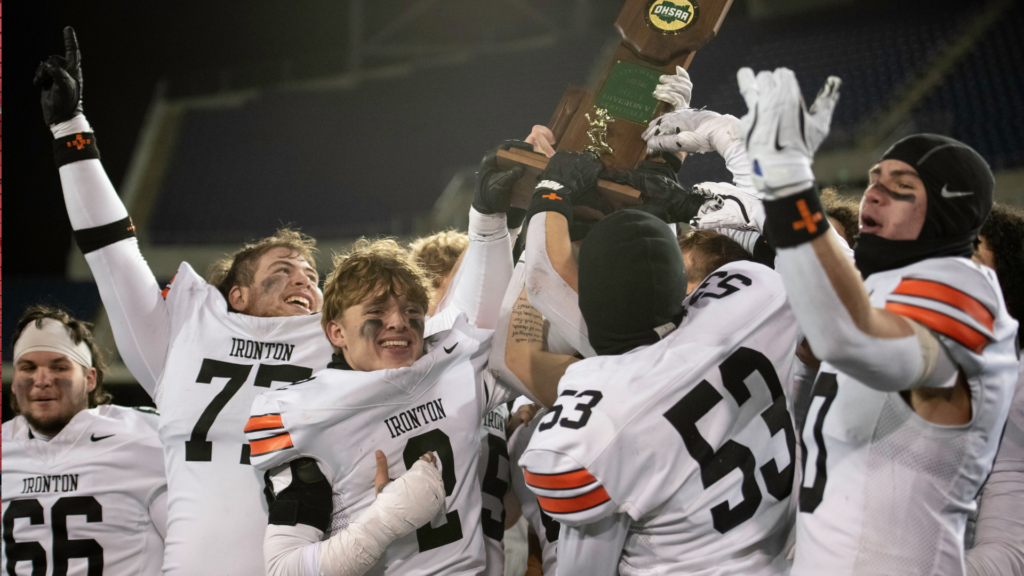
The Fighting Tigers are three-time state championship winners, most recently in 2024. Although the OHSAA allowed the school to retain its most recent title, the team suffered multiple consequences. These included a 2025 postseason ban, a suspension of specific coaching members during the 2026 postseason, three years of probation, and a $7,500 fine. Additionally, Ironton’s last game of the 2025 season, a 55-13 win against Portsmouth, was ruled a forfeit. Despite no restoration of his eligibility by the OHSAA, Grace played in this game and scored a touchdown.
Ironton’s coaching ban applies to head coach and athletic director Trevon Pendleton, among others. Pendleton is the winningest football coach in Ironton history, boasting a 90-16 record in his seven seasons with the team. With Pendleton at the helm, Ironton has gone to the OHSAA tournament every season except 2025 and has made it past the first round in six of those seven seasons.
In January, the Ironton School Board voted to keep Pendleton as the Fighting Tigers’ head coach, but to relieve him from his duties as athletic director. Ironton’s athletic department made significant changes, reimagining the Athletic Director title to Director of Transportation, Food Service, and Athletics, which is now run by Toben Schreck, the former Director of Transportation.
Pendleton did not respond to interview requests for this story.

Senior receiver Maddix Markel told WOUB in November that when his team received news of its postseason ban, they cried together, but their spirits were lifted the day of the game. He said he was grateful to play in Tanks Memorial Stadium one last time with his guys.
Seth Sammons, father of Ironton star running back Zayne Williams, describes the hurt that tore through his family because of the OHSAA-sanctioned consequences, particularly the postseason ban.
“Nothing can be done for my two sons to get their season back,” Sammons says. “They have moved on, and we prefer to do so as well.”
Ironton’s controversy is one of several that reveal sthe complexity of high school athletics across the nation. Whether at the professional, collegiate or high school levels, scandals occur in all forms, mainly stemming from recruiting issues.
Villa-Angela St. Joseph High School (Cleveland, OH)
Like Ironton, the Cleveland-based St. Joseph’s football team found itself in turmoil around OHSAA tournament time in 2021. The scandal centered around Vikings head coach Jeff Rotsky, who violated bylaw 4-9 by having impermissible contact with prospective student-athletes and their families at a basketball tournament he attended in Northeast Ohio.
This was brought to the OHSAA’s attention after the St. Joseph’s football team grew to 94 members from 61 the previous year. Rotsky was suspended from the first three rounds of postseason play, and the school was fined $5,000 for the program violations. Rotsky sued the OHSAA, a lawsuit where he partly claimed antisemitism played a role in his suspension and obtained a temporary injunction to coach in the playoffs. The Vikings made it to the second round before losing to Glenville.
A similar incident occurred in 2023 at Elyria Catholic High School, whose head football coach, Chase Farris, was accused of having impermissible contact with students who weren’t yet enrolled. The Elyria athletic department was placed on probation for the rest of the academic year, and the football staff was required to attend a recruiting seminar. Although allegations were never confirmed, Elyria was “publicly reprimanded,” according to the OHSAA’s statement on the matter.
Walsh Jesuit High School (Cuyahoga Falls, OH)
Walsh Jesuit High School’s women’s soccer and wrestling programs faced recruiting allegations in the winter of 2020. The high school self-reported its infractions of the OHSAA bylaw 4-9 by accepting donor-funded scholarships for 11 student-athletes. Bylaw 4-9-4 states that “providing financial aid based on athletic ability” is prohibited and is considered a violation.
“For both public and non-public schools, recruiting is not permitted,” Stried says. “There aren’t separate rules.”
The scandal led to the termination of historic Walsh –Jesuit women’s soccer coach Dino McIntyre, who founded the program in the early 1990s. He coached for nearly 30 years and led the team to 10 state championships. The school also suspended wrestling coach David Mariola Jr., who was reinstated over a month after the controversy.
Although Ironton was unable to compete in the OHSAA tournament in 2025, they’ll pick back up in the summer, hoping to end the 2026 season on a higher note. The Fighting Tigers will open their season against Williamsburg in August.
As for the OHSAA, Stried highlighted the importance of integrity in high school athletics but said that the organization will proceed as usual.
“The situation with Ironton will not result in any changes to OHSAA bylaws,” Stried says. “When a member school commits an infraction, it doesn’t change the mission and purpose of the OHSAA.”
Find us on Social Media