
“How many people in here have kids?” Michelle Mays asks when she addresses crowds as a guest speaker. “How many have 18-year-olds and up?” she asks. Then, “When they turned 18, did you kick them out and tell them to ‘figure it out?’”
That final question describes the lived experience of around 20,000 foster youth in the U.S. every year who age out of the foster care system. Mays is the founder, president and CEO of FosterHub, a nonprofit organization that provides resources, transitional housing and support for foster youth who lose their support systems at 18.
“Foster kids aren’t in foster care because they want to be. They’re in foster care because, for some reason, the parents that they were given have not been able to take care of them, and it’s not their fault,” Mays says.
About 20% of foster youth become homeless upon aging-out, and only 50% will be employed by age 24, according to the National Council for Adoption and the National Foster Youth Institute. Mays’ mission is to improve these numbers.
FosterHub helps provide guidance through processes such as opening a bank account, securing health insurance, acquiring a driver’s license, and obtaining youths’ necessary legal documents, such as birth certificates.
Through FosterHub, youth have access to budgeting and financial literacy training, receive help with resumes and job interviews, and make connections to wellness and mental health resources. FosterHub also partners with other local organizations and community members to help young people materially, financially and emotionally as they build a stable life.
The stakes are high. The National Foster Youth Institute estimates that of youth who age out of foster care, approximately 70% of women will be pregnant before they turn 21. About 80% of men will be arrested within six years of aging out, and about 60% will be convicted of at least one crime, according to the National Council for Adoption. Approximately 25% will experience Post-Traumatic Stress Disorder, according to the University of Pittsburgh Medical Center and the National Institute of Health.
Drawing from a Dream
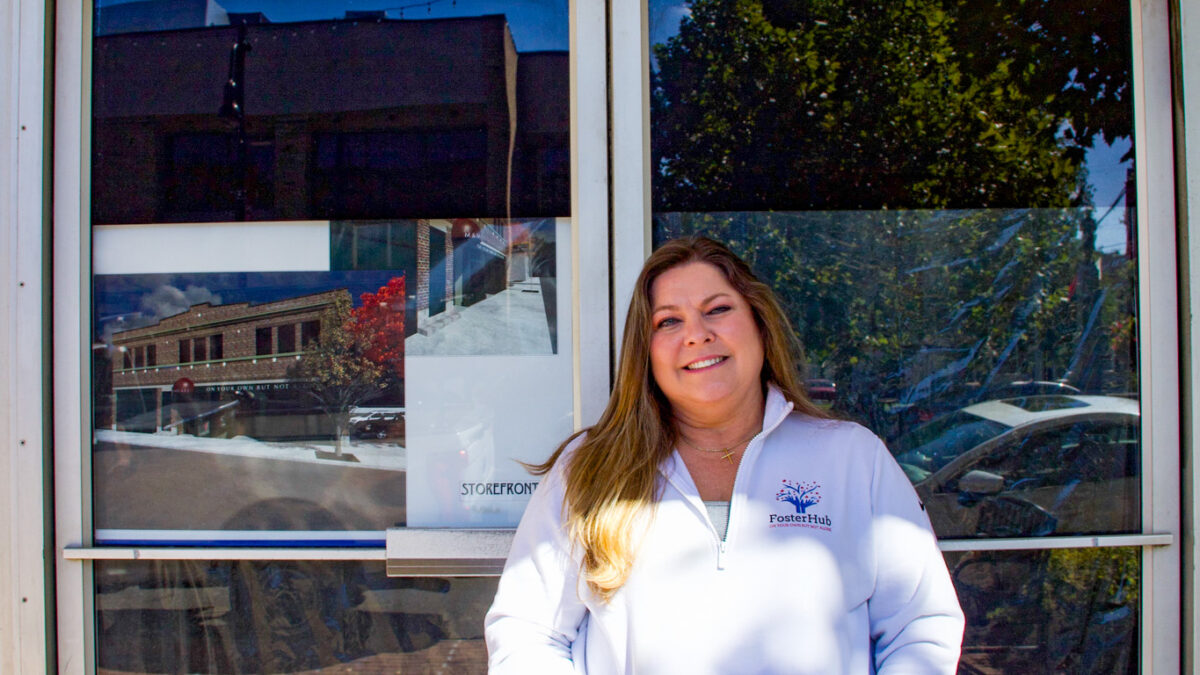
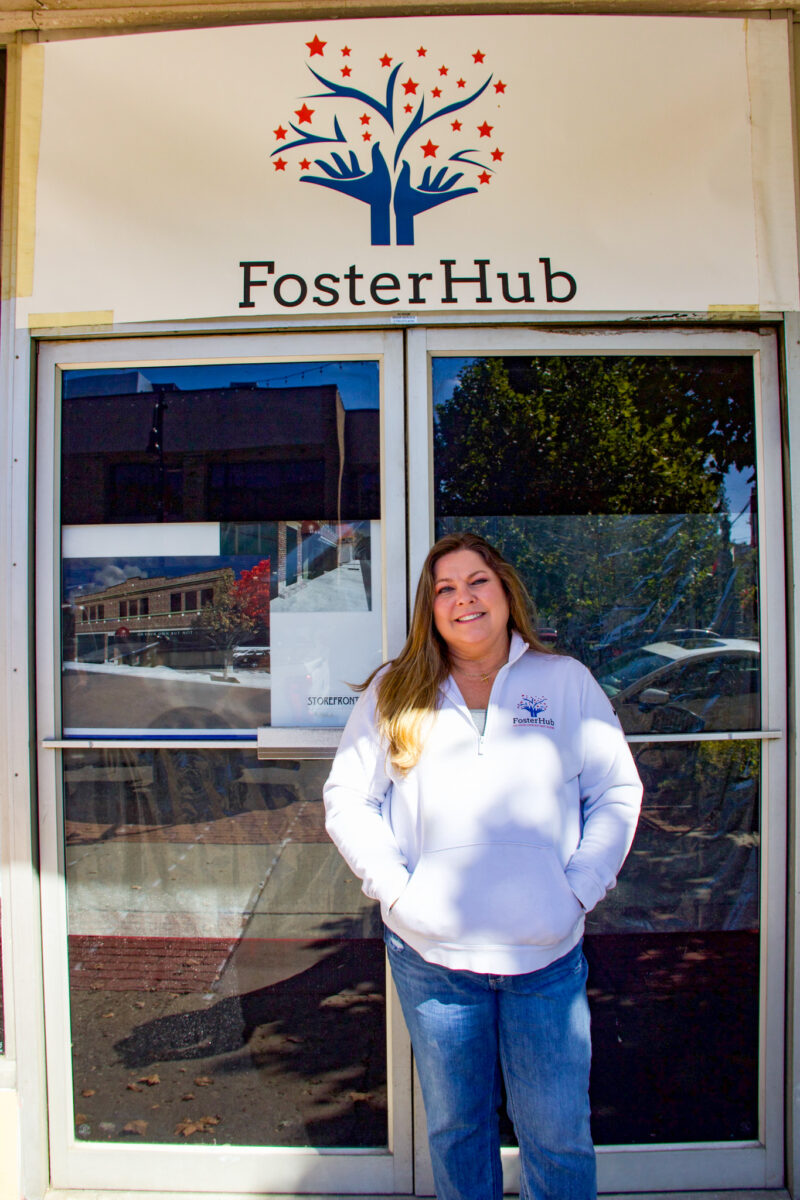
As she walks through the construction zone, Mays greets those at work with friendly conversations and a self-assured smile. With styled hair and a white FosterHub quarter-zip, she looks much younger than 52, as she shares the story of how a new FosterHub center came to be, with candid sincerity.
Mays’ vision began with storytelling. She and board member Michelle Moons collaborated on the “Dumpster Doll” series, books chronicling Mays’ personal journey through tragedy, trauma, and her own experience aging out. Mays, however, wanted to do more.

One night, Mays had a dream of a safe home and community center.
“It was so realistic that I got up and drew it. And I am not an artist at all. I didn’t know why, I was just doing what I thought I was supposed to do,” Mays says.
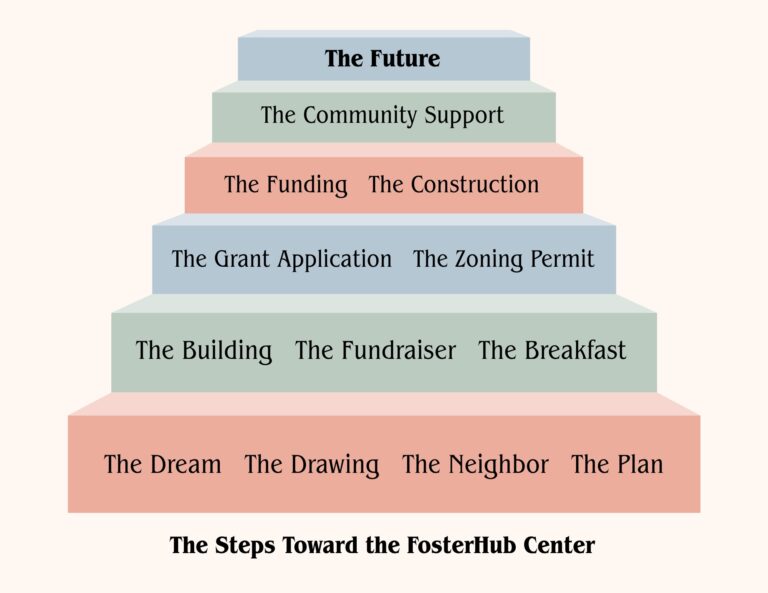
After drawing the envisioned building by hand, Mays made a 3D walk-through computer model. Later that day, she went to a cookout, where she was approached by a neighbor she hadn’t met before. He worked for a construction company that occasionally took on charitable cases, and he asked if she might need help with something.
“I had not told anyone about this drawing or this dream yet. No one,” Mays says.
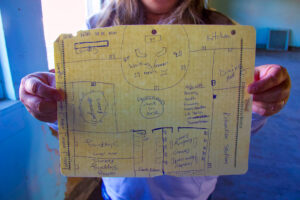
Mays displays the original plan she drew following her dream.
Photo by Rachel Yount
She showed him her drawing and he thought it was a great idea. However, he advised her that she would need a building before any company would be able to get involved. With the help of her son, a real estate agent, Mays began the search for the right location.
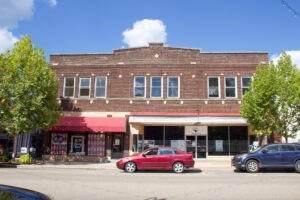
In downtown Logan, a 20,000-square-foot building built in 1914 had been almost entirely vacant for about 23 years. It was the perfect space for the new center, but it was listed at $640,000, and Mays needed money for a down payment. The Logan Moose, where Mays would DJ karaoke, threw a fundraiser and raised around $48,000.
“I was like, ‘All right. Now I need to find the rest of the money. How am I going to do that?’ And I pray to God,” Mays says. “Then I get a text. This is so weird. Every time I pray for help, I get someone within a day or within a couple days. I get a text from Tina Husted.”
Tina Husted is the wife of Jon Husted, a Senator and Ohio’s Lieutenant Governor at the time. The text read, “I just read your first book, and I’m halfway through your second. I absolutely have to meet you. Would you please come to my house for breakfast?”
At breakfast, Mays showed Tina the walk-through model, explaining her mission to do more for her kids.
“She said, ‘Who’s helping you with this?’ And I said, ‘Nobody yet! I don’t know the first thing to do!’ And she starts texting people,” Mays says.
Suddenly, Mays was in meetings with the Appalachian Children’s Coalition, Sunday Creek Horizon and Buckeye Hills Regional Council. Then, Nationwide Children’s Hospital informed Mays of a grant with the potential to fund the renovation of a historic downtown building. Before long, Mays had her building.
Zoning Controversy
Mays’s building is located in a B-1 business zone, and she needed a conditional use permit to allow residents to stay overnight. During an August meeting of the Logan Zoning Board of Appeals, over 20 members of the community showed up to voice support for, or opposition to, FosterHub’s goal of moving downtown.
Some local business owners supported the idea of the FosterHub center but disagreed with the location. Attendees debated the legality of the zoning permit and expressed concerns that FosterHub’s presence would harm local businesses. Others passionately voiced support for the project, and the zoning permit was eventually granted.
“We want the kids to see the community around here. And so far, this community has really stepped up. They hire our kids; they mentor our kids,” Mays says.
Logan Mayor Greg Fraunfelter is a proponent of the project, emphasizing the importance of having FosterHub’s resources available to local foster youth, and taking no issue with the downtown location.
“I love it. It’s something that we really need,” Fraunfelter says, recalling his 40-year career as a teacher. Over the years, “there were so many young people that were sleeping in cars and having to go into the school to take showers … They were kind of stuck out there on their own … I believe FosterHub is the way to help them.”
A Center for Hope
The basement will house training rooms, a laundry facility and a “shopping area” where youth can pick out donated necessities such as clothing, hygiene products, cleaning supplies, furniture and more. Mays plans for classrooms, offices, three ADA-compliant apartments on the first level and seven more apartments upstairs.
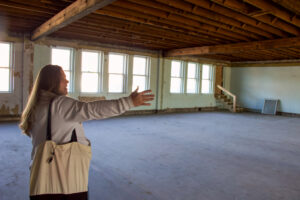
Mays gestures at the space that will be converted into apartments. Photo by Rachel Yount
While FosterHub focuses on the transitional period, the organization wants to form ties that last. Like Mays, some youth who have been helped by FosterHub are paying it forward by mentoring newcomers.
Community partnerships have also been integral. Ohio University Professor Thomas Stevenson is mentoring youth in cooking and hospitality, Culinary Arts Instructor at Tri-County Career Center’s Katie Mosher is assisting in the kitchen, and local hospital staff will provide nutrition education. A rooftop garden with a greenhouse will provide fruits and vegetables for a cafe downstairs. The central location will help area businesses get involved when the center opens in May 2026.
Senator Husted also provided a statement on the project: “I spent the first two months of my life in foster care before being adopted by my loving parents, and that experience shaped my belief that every child deserves a secure and loving home. Unfortunately, many young people never receive or lose that support when they turn 18. That’s why I’m truly excited about FosterHub’s new youth center in Logan—it will give these young people the support, skills, and encouragement they need to find their path to a more hopeful future.”
Mays’s dream is becoming reality.
“When I aged out of foster care, I didn’t have all of this, so pretty much everything we’re doing here is everything I wish I had,” Mays says. “It’s going to take a village and a community to show these kids that there are good people out there, and that they’re not less than.”
Related posts
What’s Inside
- Behind the Bite (68)
- Features (124)
- In Your Neighborhood (102)
- Photo Essay (4)
- Read the Full Issue (8)
- Talking Points (48)
- The Scene (15)
- Uncategorized (3)
- Web Exclusive (5)
- What's Your Story? (21)
Find us on Social Media