


When author, artist and activist Madeline ffitch moved to Athens County 16 years ago, her first winter was one of the harshest Southeast Ohio had seen in recent years. While attempting to homestead a section of land, ffitch wondered if she’d made a mistake. She was accustomed to the gray, yet generally mild winters of the Pacific Northwest, where she was raised. But one winter day, ffitch went hiking in Hocking Hills and looked at dramatic ice formations.
“I just thought, I’m going to stick it out and stay here,” ffitch says. From that moment on, Ohio became home.
On a warm morning, ffitch sits at a small table next to a window at the Village Bakery in Athens, hands wrapped around a large mug of hot coffee.
“I’ve always been a writer, since I was a little kid,” she says. “That’s just the thing I’ve always done, since I could write.”
Stay and Fight
ffitch, whose name is customarily spelled with two lowercase F’s, is the author of several short stories, as well as the novel Stay and Fight published in 2019, which explores themes of family, community and activism in Appalachian Ohio.

Stay and Fight tells the story of Helen, a Seattle-born-activist, who homesteads the land. She meets a lesbian couple with a baby boy on the way, forming a mini-matriarchal commune in the words.
The novel was reviewed by prestigious national publications such as The New York Times, O: The Oprah Magazine, The Wall Street Journal and Vanity Fair. It was a finalist for the PEN/Hemingway Award for Debut Novel, a Vulture Best Book of 2019, and a Publisher’s Weekly Book of the Week, among other awards and honors. The novel received praise for its prose, wit, and nuanced portrayals of Appalachian characters.
ffitch has also written numerous essays and short stories, with some compiled in her book Valparaiso, Round the Horn. Another story, Stump of the World, was also featured in The Best Short Stories 2025, edited by Edward P. Jones.

Creative Inspiration
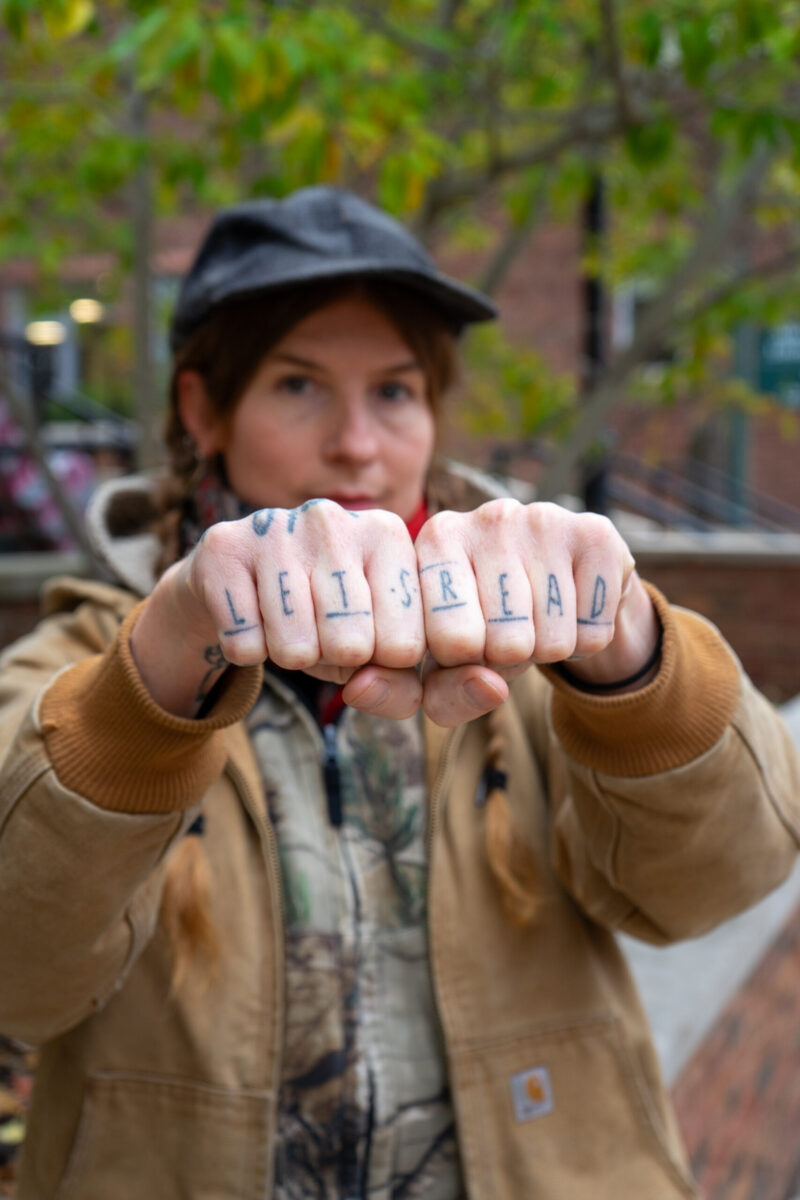
“Literature is something I care a lot about,” ffitch says. “The best way to learn how to write is by reading as many books as you can,” she adds, holding up her hands to show that the letters tattooed across them spell out “Let’s Read.”
Ohio University Fiction Professor Patrick O’Keefe taught and worked alongside ffitch as she completed her PhD in creative writing. He has also invited her to speak to his undergraduate classes about her writing process and how that intersects with her activism.
“Madeline is always deeply engaged, in whatever she’s doing. In reading, in writing, in her activism, it’s always done at a level of real intensity and generosity, and intelligence … she’s kind of remarkable,” O’Keefe says. “Her work ethic is intense, and I think it takes that type of work ethic to write a novel like that, and to write the way she does, and do all this other important work to her. And of course, be a parent.”
Reading countless novels as a child helped ffitch develop her writing style and unique voice. She revisits many of the same books she read growing up as she reads them again to her own children – books like The Hobbit and Roll of Thunder, Hear My Cry.
“I love that propulsive storytelling. But then, when I started to develop more as a writer, when I grew up a little bit, I started noticing … writers who made me realize that you could do things with style that were completely magnetic and convincing to me, like I could not put that kind of work down,” ffitch says.

At Home in the Wild
Initially, her property had no buildings, electricity, or running water. There, ffitch and a few friends built a home from the ground up, where she is currently raising her two children.
“You know, people might say they want to move out to the woods and just get away from it all. But you get out to the woods, and you realize: you drink from the spring, you drink from a well, you’re reliant, really reliant on the land. Everybody’s reliant on the land, but rural people know that firsthand,” ffitch says.
“Once I got here, it’s hard to leave. It’s a really beautiful, powerful place with really interesting history and really good neighbors,” ffitch says. “I feel like neighbors really look out for each other.”
For much of her life, ffitch has been influenced by and participated in experimental arts scenes, creating alongside musicians and performance artists. The notion of pushing the boundaries of narrative appealed to her. Her early literary influences, mixed with a resistance to convention and a willingness to experiment, helped ffitch develop her authorial voice.
“My aunt is a professional storyteller, and my family is very steeped in folk tradition, so I love a good story … but I also love this kind of asymmetry and weirdness, wildness, kind of untamed quality, and mystery. I like mystery, like the pieces that don’t quite fit,” ffitch says.
Art, Activism, and Impact
ffitch’s family history, as well as her upbringing, influenced many of the themes explored in her writing and her activism. She comes from a family wherein her parents opposed the Vietnam War while her grandparents were coal mining union organizers in the north of England.
“To me, civic participation and movement participation is something I grew up with as something you just do. Nobody can do everything, but everybody does what they can,” she says.
ffitch does what she can. She has worked alongside friends with a history of organizing against the oil and gas industry. Some of her earliest forays into activism in Athens County focused on environmental justice and the economic concerns that accompanied unfair treatment by larger corporations. ffitch says her justice-oriented work is a matter of necessity.
In 2012, ffitch proved this point when she was arrested as part of a local anti-fracking group, Appalachia Resist. Her arms were locked into cement-filled drums to block the entrance.
“I don’t actually consider myself very political … I’m an artist and I’m a writer, and I consider my poetic and my political imperative to be the same,” ffitch says. “Any writer who is worth their salt is considering deeply human questions about power and community and conflict that’s central to our craft.”
Writing Against the Status Quo
Growing up in the Pacific Northwest in the 90s, ffitch recalls neo-Nazi organizing as a scary part of her adolescent years. She was always grateful for those who were vocally opposed to the fascist movements because of the way they stood up to the bullies, and she attributes her current convictions to those same values.
“You can call it whatever you want, but when people see their neighbors getting kidnapped and seeing families being torn apart, people know that that’s wrong. And people will stand up, and people will get in the way. And that’s very fundamental,” ffitch says. “Even if they don’t succeed, the fact that they took their chance and that they tried to do something is pretty fundamental to people’s sense of humanity. And authoritarianism tries to crush that fundamental sense of humanity.”
Her next book will be more overtly political, ffitch explains. The novel will be set in 2017, during a surge in white supremacist ideology, about people who consider themselves activists.
“It’s very unusual for me in my fiction writing, but I think the sort of unlikely affinities of characters, the sort of open, big imagination, the kind of ‘writing against the status quo,’ writing against the expected or conventional narrative, that is, at its core, anti-authoritarian … so those things go together,” ffitch says. “Any art that’s worthwhile will always find itself at odds with an authoritarian sensibility.”
ffitch’s next novel will be published in October 2026. A collection of short stories will follow in 2027.
Related posts
What’s Inside
- Behind the Bite (68)
- Features (124)
- In Your Neighborhood (102)
- Photo Essay (4)
- Read the Full Issue (8)
- Talking Points (48)
- The Scene (15)
- Uncategorized (3)
- Web Exclusive (5)
- What's Your Story? (21)
Find us on Social Media