
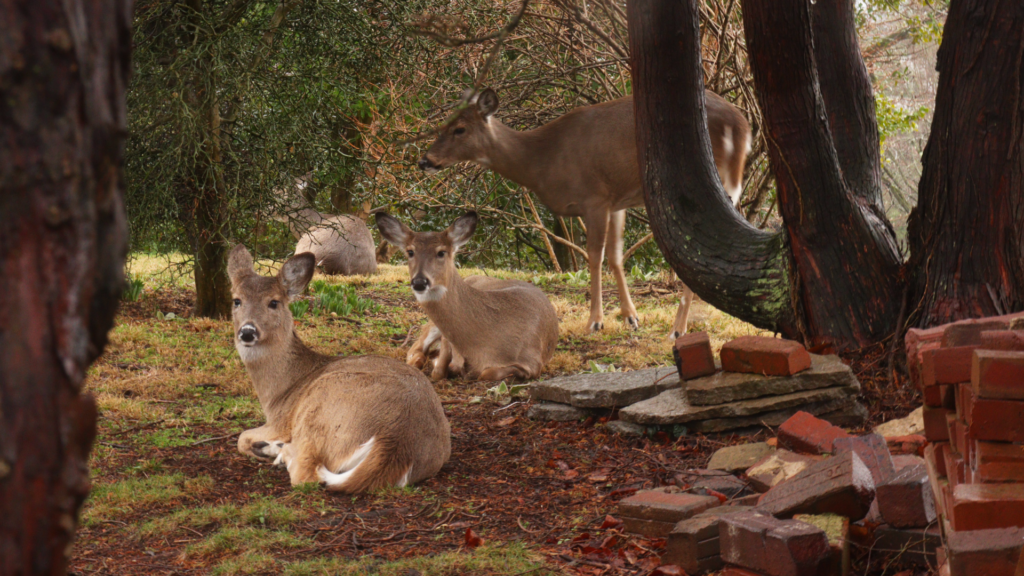
Jodi Proger, a former Belmont County resident, was known by her family as an animal lover to her core, with one member of that family being an actual animal. In 2013, when Proger saw a doe killed by a car and a distressed fawn nearby, she scooped it up, took it home, named it Wheezer and raised it as if it were a dog.
Proger obtained a permit to keep deer on private land, and in 2019 adopted a doe she named Daisy. Six years later, in November 2025, Proger was killed on her property by a different adult buck she was rehabilitating on her property who was ‘in rut,’ or attempting to mate, which increases a buck’s state of aggression and energy and reduces caution.
This fatality is an unfortunate anomaly, but it highlights dangers that can accompany wildlife rehabilitation or domestication. State law dictates that keeping most wild-born animals is illegal, though permits have been issued (usually to wildlife sanctuaries) to keep “non-releasable” animals that are too injured or over-habituated to return to the wild. In addition, only spotted fawns can be housed for three days before being released into their natural habitat.
In Proger’s case, she knew Wheezer could not survive in the wild and would be euthanized if confiscated by the state, so she refused to surrender him. After receiving a permit to keep him in 2016, she obtained a deer propagation permit in 2024 and operated a ‘rehab center.’ Without a license to rehabilitate wildlife and despite the deer-rehab ban, she shared her efforts on Facebook with her online supporters, whom she called “Wheezer Warriors.”
But aside from domestication concerns, reasons for restrictions include the potential for rapid spread of disease in deer populations, public safety concerns about unpredictable animal behavior and animal welfare.
Mike Rex, chairman of the ODNR Wildlife Council and treasurer of the Buckeye Big Buck Club, explains the ‘powder-keg’ potential for disease spread among deer with a recent example. “This past year, we had an [Epizootic Hemorrhagic Disease] outbreak unlike anything we’ve ever seen in the state,” Rex says.
An “unprecedented” number (9,281) of sick or dead deer associated with EHD was reported in 2025. Herds become especially vulnerable once they reach the land’s carrying capacity, requiring a different type of human intervention for “the good of the herd.”
“Without hunting, the deer population would explode, and more than likely, disease would take over,” Rex says. “Mother nature has a way of self-regulating, one way or the other.”
Flight animals, such as deer, adapt poorly to captivity and are highly sensitive to stress. Deer are also prone to contracting capture myopathy, a fatal condition triggered by extreme stress and often induced by captivity, in addition to harm caused in attempts to flee.
Fortunately, most calls to the ODNR about orphaned fawns turn out to be false alarms.
“Does leave their fawns to go feed, and then they’ll come back to them to nurse them,” Rex says. “People find those fawns, and they think they’re orphans, but they’re really not.” Fawns are prepared for the wait, being virtually scentless and covered in white spots that provide camouflage.
When asked what someone should do if they find a fawn they believe is orphaned, Miller offers simple advice: “Just call. Before you touch it, before you feed it, just call.”
If you think you have found an orphaned fawn, observe it from a distance, so as not to leave a scent behind or attract predators, and contact one of the listed wildlife rehabbers.
Although fawns are still more likely to receive a second chance through wildlife rehab than deer, Erica Miller, owner and operator of Erica Miller Wildlife Rehab, says she finds it necessary to heed the three-day maximum and maintain distance between fawns and humans. “They’re wild, so they grow up wild,” she says. As one of few rehabbers licensed to rehab fawns, Miller has seen successful cases and those beyond help.
Miller notes that social media platforms often add to this dilemma, as posts with animal content tend to be popular, especially posts featuring unusual pets, and baby animals. “People will have a baby raccoon, and they’ll keep it in a 70-degree house wearing a little t-shirt,” she says. “Then, it starts to get cold outside, and it hasn’t gone through the light/dark cycles of the days or had to forage food. So, what do you want me to do? If it’s too humanized, rehabbing it is useless.”
“They got their selfies and cute pictures, and then they don’t see the end—I do,” Miller says. “I have to deal with the devastation of an animal that was failed by humans.”