
Vina Colley started working as an electrician at the Portsmouth Gaseous Diffusion Plant, known locally as “The A-Plant” or PORTS, 45 years ago when she was 34. She was healthy and energetic and passed every screening test from her doctor to make her an eligible worker. It wasn’t until three years later, in 1983, that she started getting sick and breaking out in rashes.
Although the plan closed in 2001, for the last 40 years Colley has demanded “The A-Plant” be properly cleaned up. By workers who are told ahead of time that they will be exposed to harmful chemicals. Because of the risk those workers are taking, Colley wants them to receive hazardous pay.


“I’ve never asked them to shut it down … They wanted me to do [that] because they needed a scapegoat, but I wouldn’t ever say that,” Colley says.
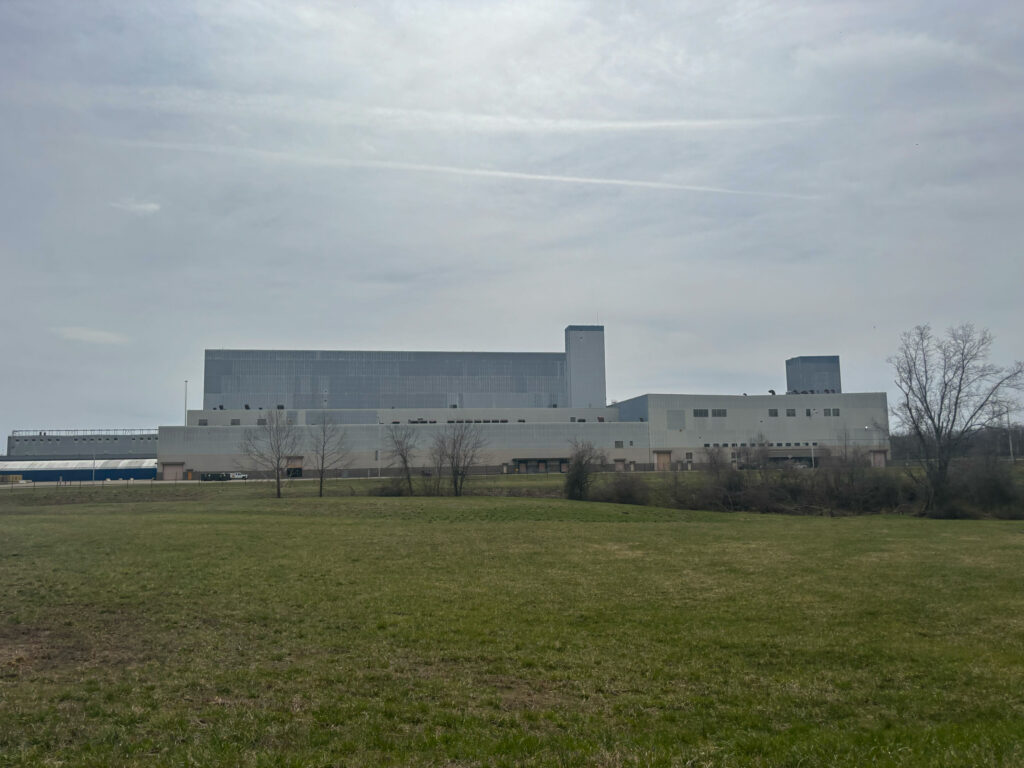
The fight intensified when the American Centrifuge Plant, located just east of U.S. Highway 23 in Piketon, announced it would begin enriching uranium in 2023. Even today, many residents and former workers face ongoing health consequences because of those plants.
Colley says it was “heartbreaking” to learn that the American Centrifuge was coming to the region. It was going to be yet another health and environmental battle she and many Piketon residents would have to navigate.
A new player came to play
Centrus Energy partnered with the Department of Energy (DOE) and Oak Ridge National Laboratory to develop the uranium enrichment gas centrifuge technology. The American Centrifuge could restore America’s domestic uranium enrichment for national security and commercial purposes, according to Centrus’ website.
The formation of centrifuges would put the U.S. at the top of uranium enrichment technology.
Before the American Centrifuge Plant, the U.S. had to rely on other countries, primarily Russia, to supply enriched uranium.
Although, a subsidiary of Urenco — an international supplier of enrichment services and fuel cycle products for the civil nuclear industry – has enriched uranium in New Mexico since 2010, it’s owned by foreign government conglomerates and European-based businesses; the New Mexico plant is the only operating commercial uranium enrichment facility in North America.
The American Centrifuge Plant is the first U.S.-owned technology enrichment plant to start production since 1954. The facility occupies about as much space as the U.S. Pentagon building, equaling about 29 acres. However, the process inside the plant is most crucial, as it is the key to producing nuclear power.
In May 2024, former President Joe Biden signed H.R. 1042, a law banning the import of Russian-enriched uranium into the U.S. until 2040 if the DOE concludes there is a threat to U.S. national interests or a risk of supply disruption.
The Bellona Environmental Foundation reported that Russian centrifuge-based uranium enrichment plants supply 40% of the world’s enrichment capacity. In the last 30 years, the U.S. has purchased 25% of the enriched uranium product it needs from Russia.


For the U.S. to achieve its clean energy goals, the DOE announced it needs new nuclear energy, and to create nuclear fuel, a key process is enrichment. For 10 years, the U.S. did not have an American-owned source of enriched uranium.
The Paducah GDP, located in Paducah, Kentucky, was the most recent uranium enriching facility plant active from 1952 to 2013. The plant was the last government-owned uranium enrichment facility operating in the U.S. Now, Centrifuge is cued to bridge that gap with its Piketon plant.
“The A-Plant's” dark history of health crises
“I believe [the government] had in their intentions to make us a nuclear dump all this time,” Colley says.
When Colley worked at PORTS, she was exposed to harmful chemicals. She was in confined spaces cleaning off radioactively contaminated oil from the electric equipment while never having to wear hazardous suits. She knew nothing else, she says.
“I thought it was the best job I ever had,” she says. “And I thought it was really safe because they wanted me to wear hard hats and safety glasses.”
Unfortunately, Colley is hardly an isolated case. Her family members from the area have their own stories to share. She lost a brother to pancreatic cancer, another brother to cell cancer, her husband to melanoma cancer, a brother-in-law to hand nodules that developed into cancer, his son to kidney cancer and his wife to breast cancer.
According to the 2023 Ohio Annual Cancer Report, between 2016-2020 Pike County had a 509.5 per 100,000 cancer incidence rate. Comparatively, between 2015-2019, the average Ohio rate was 465.3 and the national rate is 449.4, meaning there were roughly 60 more cancer incidents in Pike County than the national average.
As a full-time employee at “The A-Plant,” Colley hardly missed any shifts, but as time passed, she noticed she was getting sick.
Her coworkers were experiencing similar symptoms and respiratory issues as well. Although she didn’t know exactly how, Colley was convinced she was being exposed to radiation. Her hair was falling out, she started having thyroid problems and she’d break out in rashes when she was handling the oil.
“Why are you guys all sitting there working on that? That’s contaminated,” Colley recalls human resources saying to her. “And I said, ‘Oh, really? Nobody told us.’ How would [I] know?”
Behind a white tarp in her garage, she holds newspaper clippings, legal documents, press releases, medical records and people’s stories inside plastic containers that tower toward the ceiling.

Colley is well known around the county for always trying to help others who have experienced the harmful side effects of working at the plant. She is the president of Portsmouth Piketon Residents for Environmental Safety and Security (PRESS) and the co-founder of the National Nuclear Workers for Justice (NNWJ).
On Feb. 6, situated next to Colley on Colley’s living room couch is Paula Spears, who is gripping a picture frame of her since-passed mother. Spears’ mother worked at “The A-Plant” for 10 years, starting as a janitor and then moving up to be the first female janitorial foreman in the plant.
It was one year ago that Spears started to open about her mother’s passing. She says Colley was graciously there to talk with her when she was ready to discuss her mother’s health and “The A-Plant.” Now, Spears works with Colley on efforts to create educational exposure about the health effects the plant causes.
Paula Spears recounts how she watched her mother get increasingly ill the longer she worked at “The A-Plant.” Her mother was first diagnosed with gynecologic cancer, underwent surgery, and one year later was admitted back to the hospital for a complete hysterectomy. After 10 years with “The A-Plant,” she decided to quit.
“I’d asked her before, ‘Mom, what do you guys really do up there?’ ‘Oh, it just has to do with rubber stuff, you know this and that.’ It wasn’t nothing she was going to reveal what was really happening,” Spears says.
Both Spears’ mother and Colley both started developing rashes on their calves and hands. Their infected areas became extremely red, crusty and itchy.
Colley recalls a time when she was working and oil spilled and a mist filled the area; she says she immediately started breaking out in rashes. However, someone still had to clean up the spill, which was Colley’s job. She says she crawled to where the oil spill was and cleaned the area, directly exposing her.
When Spears’ mother’s condition worsened, she got an allergy test, which showed she was allergic to petroleum. She was sick on and off again for the remainder of her life.
Spears says her mother’s illness would clear up whenever she was away from the plant, but in 2010 she noticed her mother was not herself – she was fatigued and had pain underneath her right rib area to her back. After years of doctor visits and hospital trips, practitioners finally noticed there was a problem with her mother’s kidneys and liver.


“She was in everything up there,” Spears says. “There’s nothing there that she wasn’t around or exposed to.”
Spears’ mother passed when she was nearly 73 years old, a premature death. Her mother was never diagnosed with beryllium disease, but Spears was convinced otherwise.
Beryllium is a metal that is used to produce many products, including cars, computers, golf clubs and electrical equipment. This type of metal is common because it’s light, non-magnetic and a conductor of heat and electricity.
Although the disease is rare today, according to the Cleveland Clinic, it has a rapid onset and progresses quickly; people can get the disease by breathing it in. Beryllium exposure can also cause a skin rash called contact dermatitis.
“She had suffered some horrible health problems all these years, on and off, and they’re to blame for it,” Spears says. “She was denied and deprived of health, income and enjoying being retired.”
Human Resources
Between 1985 and 1987, Colley took a leave of absence from “The A-Plant” because she was too sick to work.
During her absence, Colley never thought anything was wrong with the chemicals she worked with until the DOE came knocking at her door questioning what she knew about the plant’s oil. After that interaction, she knew something was wrong at work.
If a worker takes a leave of absence from “The A-Plant”, then they were supposed to keep their ranking, but that wasn’t the case for Colley, who lost her seniority as an electrician.
The plant sent her to a doctor in Portsmouth, but wouldn’t pay him to examine her, so the doctor cleared Colley to go back to work. But she knew she was not healthy enough to work. Due to her inadequate health and lack of care, she made the decision not to return.
“I lost my seniority, I lost my job, I lost my benefits and I’m still sick, [and] I ended up having beryllium disease,” she says.
Colley says the area’s job opportunities with the most funding relates to the DOE. She says the government conducts community feedback surveys about the nuclear plants, but the list of people who are included in the interviews is exclusionary.
No one in the area wants nuclear power near their homes, she says; the only people invited to the meetings are plant workers and businesspeople.
In 1989, the DOE established the Environmental Cleanup Program for “The A-Plant” site. Six years later, the land was turned over to the Southern Ohio Diversification Initiative (SODI), which DOE designated to be the Community Reuse Organization for the site.
The SODI is a community reuse organization the DOE initiated to serve Pike, Ross, Scioto and Jackson counties. The organization’s goal is to bolster the economy, utilize land and facilities and support local industry.
So far, the group has given 300 acres of the site’s 3,777 acres, which includes the surrounding land, according to The Columbus Dispatch. Other parts of the land were sold off to companies such as Trillium and Oklo, which are interested in building a hydrogen-fueled power plant and two nuclear power plant reactors on the site, according to the Dispatch article.
Oklo Chief of Staff John Hanson told the Chillicothe Gazette in 2024 that Piketon residents understand and approve of nuclear power.
This sentiment could be linked to an initiative to create more job opportunities in the area, which has an above poverty rate.
A 2020 Ohio Poverty Report documenting 2014 to 2018 found 19.4% of Pike County was impoverished. The statewide poverty rate was 14.5%, indicating nearly 5% more Pike County residents experience poverty than the rest of Ohio.
The Fallout
On Feb. 6, Paul Mobley is an independent operations engineer and an anti-nuclear activist from northwest Indiana. After reading about the enrichment facilities in Piketon, he said he wanted to do work there, which is then when he was introduced to Colley.
Mobley is testing gamma and X-rays and alpha and beta particles. He is interested in testing the surrounding area of the plant’s site to find if anything is contaminated. One sample from Little Beaver Creek, which is near the plant, yielded a beta level that was three times the legal limit set for surface soil contamination.

The Scioto Valley Guardian reported the contamination in the creek was traced to outflows from “The A-Plant” on-site radioactive waste-dump.
“It came to a point where [“The A-Plant” was] taking the PCB oils that was contaminated with radioactivity and chemicals, and they were just dumping it right into the ground,” Mobley says. “All that did was deeply contaminate the entire site.”
Mobley posts his data to TikTok under the username @cobbwebb3 and YouTube handle @paulmobleyscience to spread awareness about the issue.
He says he is dedicated to collecting data and sharing it to help hold “The A-Plant” accountable for their lack of transparency in the site’s cleanup efforts.
“It’s criminal,” Colley says. “Eventually, somebody should go to prison for all this. It’s murder. We’re guinea pigs.”
Although the American Centrifuge is already enriching uranium and has multiple other plans to add more nuclear plants to the site, Colley and concerned Piketon residents say they are committed to ensuring the radioactive contamination at “The A-Plant” get cleaned up.
“You haven’t even finished so called cleanup, not that it was ever done correctly, and you’re already bringing in more,” Spears says. “There is no subsequent thing as clean nuclear energy at this point in time.”
In 2022, the Scioto Valley Guardian reported on the radioactive cylinders at the site.
- There are over 20,000 uranium hexafluoride cylinders.
- Nearly 2,000 low-enriched uranium cylinders
- 18,000 depleted uranium cylinders.
- Almost 400 empty cylinders.


Those cylinders have been openly stored for decades and contribute to some of the highest sources of radioactive contamination at the entire plant site, according to the article.
Compensation
In 2024, Sen. Sherrod Brown, (D-Ohio), supported adding Pike and Scioto counties’ zip codes to RECA’s new Nuclear Storage Exposure Provision. The addition would guarantee Ohio workers and residents adjacent to the DOE’s site in Piketon are also made eligible for compensation due to the improper storage of radioactive material.
But Colley is in it for the long fight. She and others are working to get Pike and Scioto Counties added to the 1990 Radiation Exposure Compensation Act (RECA), which provides a one-time benefit payment to people who have become sick or died due to radiation exposure, according to WKBN.
Colley has testified to Gov. Mike DeWine demanding RECA support, sent over packets with data collections to Vice President JD Vance and spoken with Brown about the bill. Portsmouth city council members and commissioners also agree with Colley and wrote letters to their representatives in Washington, D.C., requesting workers and residents be eligible for RECA.
Although Colley’s goals haven’t yet been reached, she calls herself “stubborn” and plans to continue advocating for change in her community and speaking out for what she believes is right until workers and residents finally get acknowledged.